






Introduce
The Special Educational Needs and Disability (SEND) Code of Practice is statutory guidance for organisations working with and supporting children and young people who have special educational needs or disabilities in England. It was implemented in September 2014 and covers a wide range of topics, including:
- Legal requirements and duties of local authorities, health bodies, schools, and colleges.
- Identification of needs and the support required.
- Education, Health, and Care (EHC) plans and how they are developed and reviewed.
- Collaboration between education, health, and social care services.
- Inclusive practice and removing barriers to learning.
- Support for transition to adulthood.
The Code is designed to maximise support for children and young people with SEND. Please see for more: SEND code of practice
Develop
What is the SEN code of practice? This video provides a handy explainer.
The SEN code of practice emphasises:
- the views, wishes and feelings of the child or young person, and the child’s parents
- the importance of the child or young person, and the child’s parents, participating as fully as possible in decisions, and being provided with the information and support necessary to enable participation in those decisions
- the need to support the child or young person, and the child’s parents, in order to facilitate the development of the child or young person and to help them achieve the best possible educational and other outcomes, preparing them effectively for adulthood (ASCL, 2016)
- Birth to work and ‘independence.’
It takes a ‘staged’ approach so that support includes:
- ‘Reasonable adjustments’ (we will discuss this further on)
- ‘SEND status’ (targeted intervention)
- Education health and Care Plans (EHC Plans) (external support).
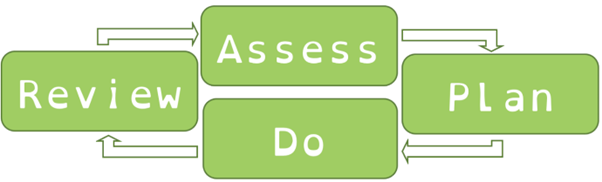
The Graduated Approach is an approach to SEN support within mainstream settings. It is recommended that settings assess children’s need and then provide appropriate support. There are four stages: Assess, Plan, Do, Review.
It is not a one off process and is recommended to be a cycle to be repeated. Through this, assessments can address children’s strengths and needs and adapt as these change or develop.
- Assess: Practitioners (along with the SENCO) are responsible for carrying out an assessment of children’s needs
- Plan: Where SEN Support is required, parents/carers should be notified. All educators, practitioners and support staff should be made aware of a child’s needs, support offered and any specific strategies required.
- Do: The planned interventions should be implemented.
- Review: Reviews should be carried out and feed back into child need assessments. The Code of Practice recommends settings meet with parents three times per year.
The graduated approach can be instigated at any time and should always involve parents. Link here:
Example: Trafford Directory | Trafford Early Years SEND Graduated Approach for Practitioners
Reflect
‘’Children have special educational needs if they have a learning difficulty which calls for special educational provision to be made for them. Children have a learning difficulty if they have a significantly greater difficulty in learning than the majority of children of the same age or have a disability which prevents or hinders them from making use of educational facilities of a kind generally provided for children of the same age in local schools.”
‘SEND Code of Practice 0-25’, DfE, 2015
Children with SEN are said to require something ‘additional to’ or ‘different from’ that offered to other pupils.
What are the issues with age related expectations of children?
Thinking back to the social model of disability, which focuses on the environment, a definition which refers to use of educational facilities may present difficulties. What if facilities aren’t fully compliant? Are there ways that your own service could improve how it meets all children’s needs?